It happened in a meeting.
I had just finished explaining an idea—clear, structured, grounded in theory—and without thinking, I ended with, “That’s what I’m fixin’ to try next.”
There was a pause.
Not confusion. Not even disagreement.
Just that slight shift in the room—like something had been filed away about me. A quiet recalibration.
I watched it happen in real time: the moment where language became perception.
A Moment That Speaks Louder Than Words
You don’t have to look far to see how Southern speech is interpreted.
Scroll TikTok for five minutes and you’ll find it—voices exaggerated for humor, accents turned into punchlines, phrases like “y’all” and “ain’t” used as shorthand for a whole identity.
Sometimes it’s lighthearted.
But sometimes it carries something sharper underneath.
Because in those moments, the accent isn’t just entertainment—it becomes evidence. Proof, in the eyes of the listener, of who someone is, what they know, and what they’re capable of.
And that’s where it gets complicated.
What People Assume vs. What’s True
There’s a script people often follow when they hear a Southern voice.
They assume:
- That slow speech means slow thinking
- That informal language means lack of education
- That a drawl signals simplicity
But that script falls apart quickly when you look closer.
Because the same voice people underestimate can:
- Lead a classroom discussion on theory and research
- Write with precision and depth
- Shift tone, vocabulary, and cadence depending on the room
Southern speech isn’t a limitation.
It’s a range.
And what sounds “casual” to some is often deeply intentional—rooted in connection, storytelling, and relational awareness.
The Subtle Shift: Code-Switching
There’s a moment many of us recognize.
You walk into a different space—a presentation, a professional meeting, a new environment—and something changes.
Your sentences tighten. Your vowels straighten. “Y’all” becomes “you all.”
Not always consciously. But consistently.
That’s code-switching.
Not as inauthenticity, but as fluency.
It’s the ability to move between linguistic worlds—knowing what each space expects, and deciding how much of yourself to reveal.
Because language isn’t neutral.
It signals belonging. Or difference.
And in many cases, it determines how seriously you’re taken before you’ve had the chance to prove anything at all.
Language Carries History
The way we talk down here didn’t just appear—it was built.
Layer by layer.
It carries the influence of African American Vernacular English, shaped by resilience, creativity, and cultural survival. It reflects the speech patterns of Scots-Irish settlers in rural communities. It holds the rhythms of oral storytelling—where meaning lives as much in how something is said as in what is said.
Southern language is not one thing.
It’s a blend. A history. A record of people and place.
So when it gets reduced to a stereotype, something important gets erased.
Not just the sound—but the story behind it.
More Than How We Speak
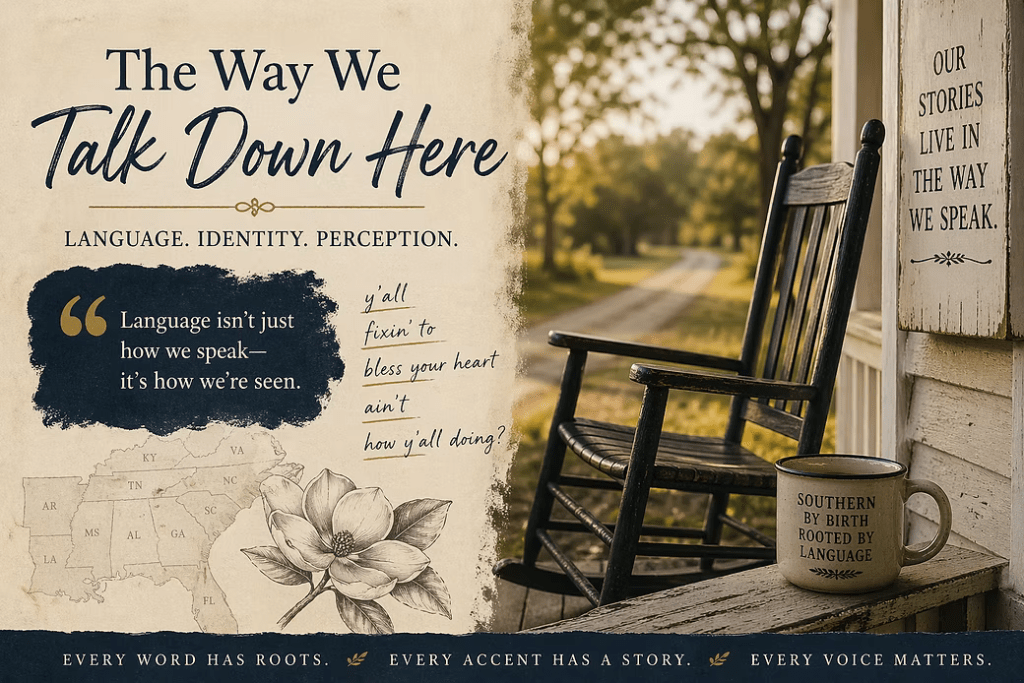
Language isn’t just how we speak—it’s how we’re seen.
And for many of us, that means constantly navigating perception.
Do we soften our accent? Do we adjust our phrasing? Do we let people hear where we’re from before they decide who we are?
There’s no single answer.
Some moments call for adaptation. Others call for holding steady.
But what matters is this:
Understanding that the way we talk isn’t something to outgrow.
It’s something to understand.
To claim.
To recognize as part of a larger story—one that stretches beyond a single conversation, a single assumption, or a single room.
Because when someone hears “y’all,” they may think they’re hearing something simple.
But what they’re actually hearing is history. Identity. Place.
They’re hearing the South.
And whether they realize it or not—
they’re already deciding what that means.
 Southern Ink
Leave a comment